A classic of the culture and cuisine of the State of Goiás gains a variety that poses no risk to beginners. The thornless pequi, developed by Goiana Agency for Technical Assistance, Rural Extension and Agricultural Research (Emater), has opened a call for the sale of seedlings of the variety. Registration is aimed at nurserymen and family farmers and will be open until the 31st of this month.
The lots with six grafted seedlings, three pequi cultivars with thorns and three cultivars without thorns, are offered by Emater in partnership with Embrapa Cerrados for the value of R$ 150 each.
Research
The study has been carried out for over twenty-five years and began on a farm. On one property, seedlings of a different species of pequi, the thornless pequi, were found. Based on this discovery, researchers carried out a plant clone. Embrapa Cerrado researcher Ailton Pereira explains how the new variety of the plant was developed.
“During the work we were developing, news came to light about a thornless pequi. For years we evaluated this material within the institution until we reached the point where it was worthwhile. So, there is a cultivar that originated from this mother plant and there are two more cultivated ones that are offspring of this mother plant. We brought it to the institution as a seed, then it grew, evaluated, and found that the one without thorns,” says Ailton.
Each nurseryman may acquire five to ten lots per CNPJ, while family farmers may acquire up to two lots per CPF. To obtain the seedlings, producers must have an active registration with the National Register of Seeds and Seedlings (Renasem) or access registration to National Program for Strengthening Family Agriculture (Pronaf), through the National Registry of Family Farming (CAF/DAP).
Symbol of Goiana culture
In the state of Goiás, the fruit is a symbol of local culture. The pequi is in the hearts of those who love the fruit. To give you an idea, there is a law in Goiás that prohibits the cutting down of pequi trees.
In addition, the fruit generates wealth for the state. According to the Brazilian Institute of Geography and Statistics (IBGE), 2,8 thousand tons of pequi were extracted in the state in 2021, production 8,1% higher than 2020 (2,6 thousand tons), representing 96,7% of all food product extraction in Goiás. This amount generated R$3,9 million reais in production value, which corresponds to 19,85% of the total production value in plant extraction in Goiás.
Sugarcane from Goiás is highlighted in Seapa publication
Gross Production Value of Goiás should close 2022 with a record
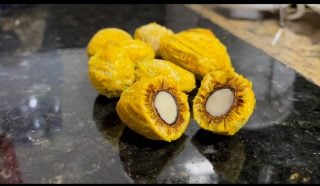
Love and hate
The pequi is one of the Cerrado fruits that divides opinions the most, as there are those who love it and those who hate it. The oily fruit, with yellow pulp and a strong aroma, is one of the main ingredients in Goian cuisine. It can be found in recipes such as galinhada, chicken with okra and even in preparations such as chili peppers or ice cream.
Despite being from Goiás, self-employed Fábio Póvoa does not like the fruit. “And those who like the pequi, really like it, but those who don’t like it, like me, can’t even stand the smell,” he says.
Industrial lathe operator Wesley da Silva disagrees. For him, the fruit is the best in the cerrado. “It’s a typical dish here at home. In my opinion, it’s the best fruit in the cerrado,” he says.
Chef and expert on the fruits of the Cerrado, Francisco Ansiliero, uses pequi in his recipes. For him, this new cultivar will make dishes that use the fruit easier. “Some people are afraid of the thorns, because it is obviously very difficult to eat. You have to eat it by scraping it slowly so as not to hurt yourself with the pit,” he says.
To purchase seedlings of the new pequi tree, which produces thornless fruit, simply access the link
https://www.emater.go.gov.br/wp/aquisicao_mudas_de_pequi/
Click HERE, join the WhatsApp group Brasilia Rural Channel and receive news in real time.
About the author