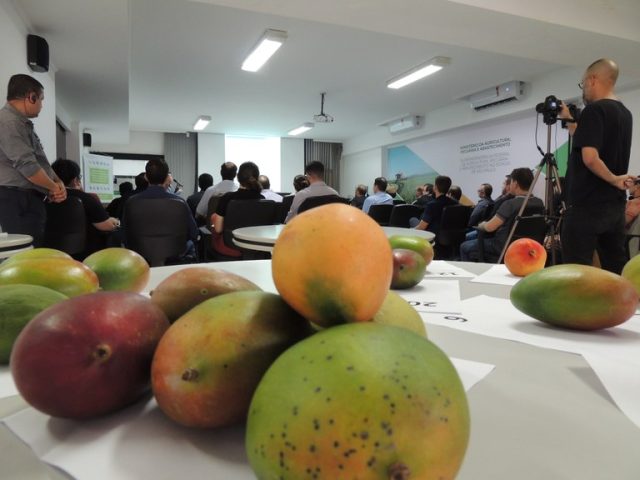
Brazil has taken another step towards increasing the export of fresh fruits and vegetables. This week, federal agricultural tax auditors were trained to act as quality inspectors of Organization for Economic Cooperation and Development (OECD).
After almost seven years of negotiations and adjustments to domestic legislation, Brazil is now ready to issue the international quality certificate for fruits and vegetables required by the organization's member countries.
“This OECD classification seeks an international standard, so it qualifies Brazil, which has excellent quality fruits and vegetables. We put it in line with an international standard, a recognized standard of quality and safety for these products so that we can access these new markets with this document recognized by the OECD,” said Glauco Bertoldo, director of inspection of products of plant origin at MAPA.
According to the technical manager of Brazilian Association of Fruit and Derivatives Exporters, Jorge Souza, the differences between the classification already made in Brazil and that required by the OECD are very subtle and mainly concern quality.
“Its purpose is to inform the consumer whether that fruit is an extra fruit, which is a 'perfect' fruit; whether it is a category S1, which is a fruit with an excellent appearance, with some small defects, which are often imperceptible to the consumer; or whether it is a category 02, where these defects are a little more pronounced. So, consequently, you will have an impact on the price or whether even that fruit is outside of any classification and, in that case, it should not be sold”, explained Souza.
Course
With the support of the union of Federal Agricultural Tax Auditors (Anffa Sindical) and implementation of the Ministry of Agriculture, Livestock and Supply (Map), the course had 44 vacancies for federal agricultural tax auditors (affas) who work in international agricultural surveillance units (Vigiagro) and partners indicated by entities in the productive sector.
In the classes, participants were able to observe defects in fruit and learn what is acceptable or not in the foreign market.
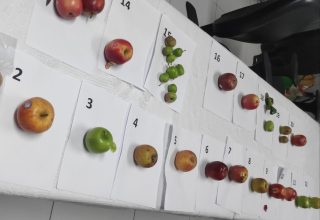
Photo: map
Jorge Souza explains how the course was. “The training was divided into a theoretical part, where we were presented with the standards for each fruit: citrus fruits, apples, and grapes. After this theoretical presentation, we went on to a practical part, where there were several samples of fruits, and each course participant had to do an assessment that served as a test, a test to see if the learning had been good”, he said.
With the course, inspectors are able to evaluate batches of these products and sign the certification, which should speed up the export flow.
“With the inspectors trained, our expectation now is that Brazilian exporters will have this additional tool to access markets, in the valorization of the product, since the OECD certification is recognized by all members of this group”, adds Glauco.
DF shows its vocation to be a technological showcase for agriculture
Thornless pequi sold by Emater-GO and Embrapa Cerrados
Market
Data released by Abrafruta reveals that Brazil earned the equivalent of one billion dollars in 2021 from fruit exports. Highlights include mangoes, with more than 270 thousand tons exported, and apples, with an increase in export volume of 58% compared to 2020. However, according to the director of the Ministry of Agriculture, Glauco Bertoldo, the country has the potential to earn much more.
“Brazil is very well-established with melons, papayas, mangos, and other types of fruit. But we export very little bananas, for example. So, we have several fruits from here in the country that have enormous potential and we hope that with this certification, we can open the eyes of these new markets and we can export more and more fruits from here in Brazil,” he said.
Click HERE, join the WhatsApp group Brasilia Rural Channel and receive news in real time.
About the author